
 Company Introduction
 Our Factory
 Development History
 Company Culture
 Our Certificates
 AUTO RGB Amusement Light
 Programmable RGB Amusement Light
 RGB LED Floodlight
 Single Color Amusement Light
 E10 E14 Turbo Housing
 Accessories
 Application Area
 Products Video
 Enterprise News
 Industry News

Please click on the upper right corner
Share it with your circle of friends
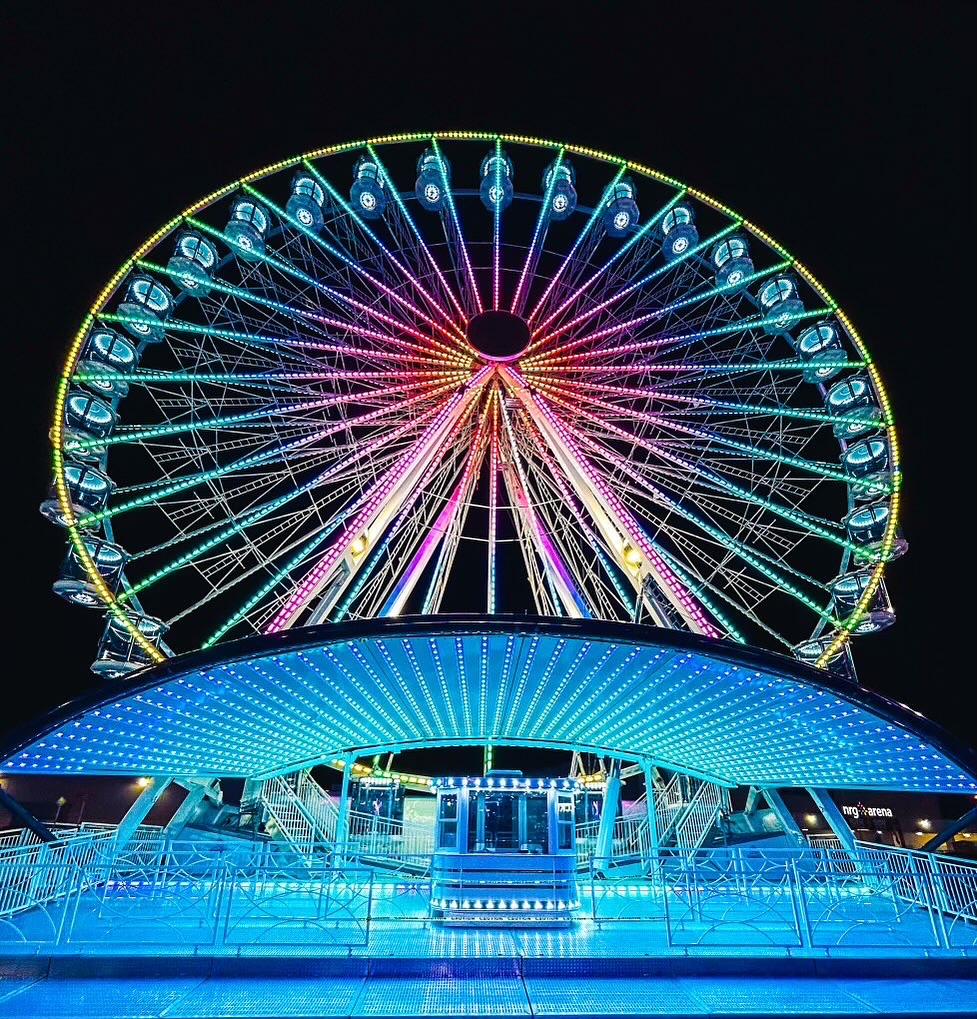
The Ferris wheel is the most recognizable silhouette at any funfair or amusement park. Its circular geometry and slow, majestic rotation make it the ideal canvas for dramatic LED lighting effects. Designing a Ferris wheel lighting system that is visually spectacular, reliable through all weather conditions, and practical to maintain requires careful planning across multiple technical and aesthetic dimensions.
 |
The Unique Design Challenges of Ferris Wheel Lighting
Ferris wheels present challenges that most other rides do not:
1. Rotating electrical connections: Power must be transferred from the static base to the rotating structure. Slip rings (rotary electrical connectors) handle this — but they add complexity and require periodic maintenance.
2. Height: Large Ferris wheels may be 20-60 meters tall. Maintenance access requires specialized equipment, making bulb replacement a costly and disruptive operation. Reliability is paramount.
3. Full-circle visibility: Unlike a carousel that is viewed from the outside only, a Ferris wheel is visible from all directions simultaneously. The lighting design must work from every angle.
4. Gondola vs. structure lighting: The lighting program must work aesthetically for both the moving gondolas (rider experience) and the static spoke-and-rim structure (external spectator experience).
Structural Zones of Ferris Wheel Lighting
Zone 1: Rim (Outer Circle)
The most visible element from a distance. Dense pixel light installation on the outer rim creates the "spinning wheel of light" effect that draws attention from maximum distance.
Recommendation:
⦁ E14 RGB pixel lights, IP67, COB flip-chip
⦁ 50mm center-to-center spacing
⦁ 16-program auto-chase, installed in ascending program order around the circumference
⦁ Result: Color appears to "spin" around the wheel, synchronized with (but independent of) the physical rotation
Zone 2: Spokes
The spokes radiating from the hub to the rim can be outlined with LED strip lights (for a continuous linear effect) or with pixel lights at regular intervals (for a dot-pattern effect).
Recommendation:
⦁ COB LED strip lights, IP67, warm white or RGB
⦁ Aluminum channel profiles (essential for heat dissipation)
⦁ For large wheels: combine pixel lights at outer positions with strip lighting along the spoke length
Zone 3: Hub
The center hub is a strong focal point. Turbo lights (high-sparkle, large-format) at the hub positions create maximum visual impact at the structural center.
Zone 4: Gondola Exterior
Each gondola (passenger cabin) is lit on its exterior for visual impact from the ground. Lighting must be on the gondola itself (rotating element) and powered via the gondola wiring from the slip ring system.
Recommendation:
⦁ 20-40 E14 pixel lights per gondola
⦁ IP67 (exposed to rain and weather when not under cover)
⦁ Auto-program 1-8 chase
⦁ Each gondola can use different program numbers to create visual variety across the wheel
Zone 5: Gondola Interior
Interior lighting enhances the rider experience. Warm LED strip lights inside the gondola roof create a comfortable, premium feel. Some operators add RGB strip lights for special events.
Control System Selection for Ferris Wheels
Auto-program (recommended for most applications): The rim pixel lights, spoke lights, and gondola exterior lights all run their built-in programs independently. No controller is required, and no data cabling needs to cross the slip rings. This dramatically simplifies the electrical design and eliminates the slip ring as a potential point of DMX signal failure.
DMX control (for show environments): Large permanent Ferris wheels at major parks or entertainment destinations can justify the additional complexity of DMX control. A DMX signal is transmitted through a dedicated DMX slip ring channel and controls each gondola's lights independently for spectacular synchronized effects.
For most travelling fairground Ferris wheels, auto-program is the practical and economical choice.
Maintenance Considerations for Ferris Wheel LED Lights
Given the height and access complexity of Ferris wheels:
⦁ Specify IP67 minimum for all exterior lights (reduces replacement frequency)
⦁ Use COB flip-chip construction (outdoor lifespan 4-6 seasons vs. 1-2 for wire-bond)
⦁ Document every bulb position with a numbered diagram — replacement is much faster when you can pre-identify which program number to bring to height
⦁ Negotiate an annual maintenance package with your LED supplier that includes replacement bulbs at a pre-agreed price